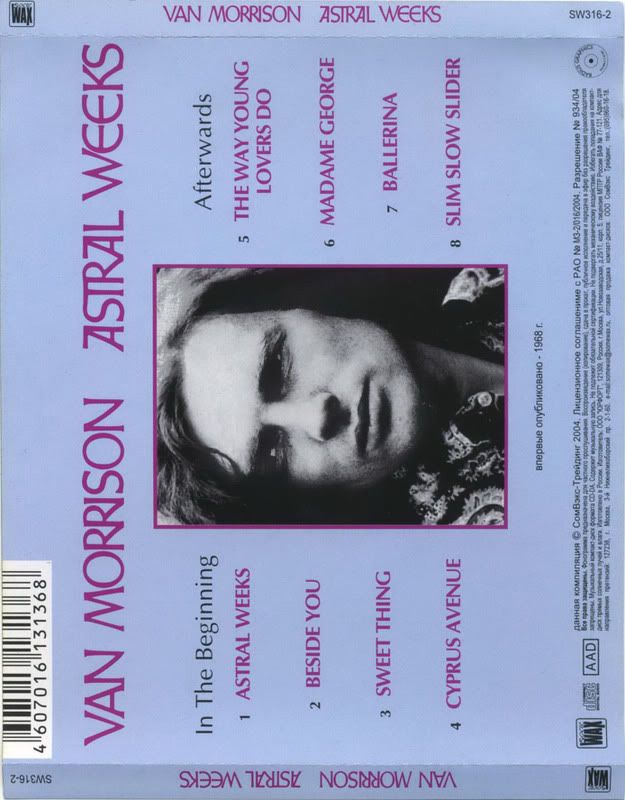
 As the years accumulate, Astral Weeks becomes less and less of a leisure grab. It's not for a lack of appreciation; it's for the crushing sense of nostalgia. Morrison wrote "Ballerina" after meeting his first wife following a gig at the Fillmore. After first meeting -- this is crucial. The song focuses upon her physical sorcery, which Morrison deftly conveys with his reoccurring image of an elegant, graceful ballerina. Celebrating the allurement of a Helen is an ancient songwriting trick, but Morrison isn't doing this because it's custom. Really, he's got nothing else to latch onto -- he has yet to discover her vices, her quirks, her charms. He only knows her face. And this is what pains. Years from now, that striking physical beauty -- which sent Morrison into a sort of "hallicunatory ecstasy" (not my words; two of Lester Bangs' 3,700 from his legendary Astral Weeks review) -- will have fled, with only aged photographs and words to venerate it. So pay homage while it still exists, while it still enchants, while it still forces you to pen the following couplet: "And I'm standing in your doorway / And I'm mumbling and I can't remember the last thing that ran through my head."

"Why not have something that sounds terrible that you can hold?" - Chris Jahnle
Monday, November 10, 2008
As the years accumulate, Astral Weeks becomes less and less of a leisure grab. It's not for a lack of appreciation; it's for the crushing sense of nostalgia. Morrison wrote "Ballerina" after meeting his first wife following a gig at the Fillmore. After first meeting -- this is crucial. The song focuses upon her physical sorcery, which Morrison deftly conveys with his reoccurring image of an elegant, graceful ballerina. Celebrating the allurement of a Helen is an ancient songwriting trick, but Morrison isn't doing this because it's custom. Really, he's got nothing else to latch onto -- he has yet to discover her vices, her quirks, her charms. He only knows her face. And this is what pains. Years from now, that striking physical beauty -- which sent Morrison into a sort of "hallicunatory ecstasy" (not my words; two of Lester Bangs' 3,700 from his legendary Astral Weeks review) -- will have fled, with only aged photographs and words to venerate it. So pay homage while it still exists, while it still enchants, while it still forces you to pen the following couplet: "And I'm standing in your doorway / And I'm mumbling and I can't remember the last thing that ran through my head."

Wednesday, November 5, 2008

Artists who have mentioned Steve Reich as an influence: Brian Eno, Kevin Shields, and Jason Pierce. That's one holy-shit triumvirate, no? Maybe I'm naive and indulging in too many priggish-classical-musician stereotypes, but after recently watching an infinity of Reich interviews, I was struck by how affable and humble and approachable he is. How he touched upon those individuals who regularly indulge in Beethoven, Bach, and Brahms, and how wonderful this is, yet: "We don't want them to be the only ones." Then a laugh. This seizes me, when it shouldn't really, since this is an artist who penned something as casual and unconventional as "Clapping Music." In speaking about that particular piece of music, Reich commented on those slight variations on traditional canons or rounds that don't tell you how to sound, but help you to think. But what I truly enjoyed hearing: How the classical music establishment thought Reich had gone crackers when he started doing performances, only to re-assess the artist in the late 1970s and decree, he's not crazy -- he's actually pretty good. "If you do something in life, you want other people to appreciate it." When do creative giants ever admit as much?
Monday, October 27, 2008
 Michael Zapruder: brother of poet Matthew Zapruder. Makes sense. The lyrics on Dragon Chinese Cocktail Horoscope are ambitious, formless, penetrating, focused. They are personal without being overly sentimental. His characters fight, seek, and reconcile. From "Ads for Feelings": "When the wholesome has married the loathsome / Can you tell me what gift I should bring?" From "White Raven": "More footsteps on the walk, then the doorbell / More coats on the rack / Good people making heaven out of hell." From "Harbor Saints": "May the tangle of your footsteps / Leave you where you feel at home." Zapruder's words are tinged with an introspective quality that only proper solitude and contemplation can bring. Two years ago, the San Francisco native recorded an album as Rain of Frogs, a collective featuring a cast of 20 musicians, including members of Camper Van Beethoven and the Decemberists. Dragon Chinese Cocktail Horoscope is less collective and more a collection of uncompromising thoughts.
Monday, October 13, 2008
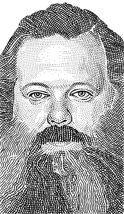 If there's one good thing to come out of all the hubbub surrounding the production on Metallica's new album, Death Magnetic, it's this: We've officially been introduced to Pixelated Rick Rubin. Be honest (you're among friends here): You've also been anxiously awaiting the day when the Wall Street Journal would run a piece featuring a quote from Rick Rubin, just so you could meet his dot-matrixed alter-ego. My only disappointment with the headshot is that it ratchets up the already present Grizzly Adams vibe by like 75 percent. Oh shit -- where's Nakoma?
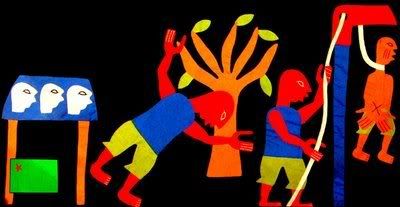
There's an interesting little tidbit I wasn't able to work into a piece I recently wrote on German DJ Frank Gossner, who spent three years in West Africa trawling for rare 45s and LPs of African funk, Afrobeat, Nigerian disco, and Ghana highlife from the 1970s. Gossner talked about African pop's role as gatherer and narrator when it came to information (in a way, I suppose, that's akin to hip-hop or even English punk). "Music means much more in African than to the average Western consumer," he told me. "Music is the main ingredient of native, African religion. Music also doubled as books and as newspapers to transport news and history."
One of the examples he pointed to was a track named "Nama" that was included on his blog's Deeper and Deeper mix. It's a classic Mandingue standard about a ferryboat sinking on the way to an independence celebration. The accident occurred in 1971 and killed 14 passengers: 13 young girls and the driver, who was named Nama. Roughly 90 seconds before the song concludes, an eerie, distorted electronic sound cuts in; the noise was recorded to mimic the metal gurgle of the boat's dying engine as it slowly sank.
It's evidence of Frank's earlier point (pop music as storyteller), with the end result being a pointed sentimentality that crosses both language and cultural divides.
Monday, October 6, 2008
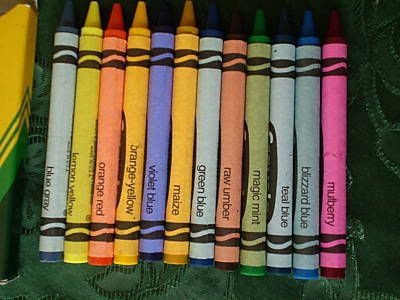 "Remember the color Prussian blue?"
"Remember? What happened to it?"
"They retired it."
"Nah, they renamed it for being too insensitive. The Prussians were rather upset at having a certain quality of melancholy attached to their culture and country. The color is now called midnight blue."
"Ah, what a neat picture."
"It is."
"But you can't blog about crayons."
"I could write about The Colourfield . . . or A Blaze Colour or The New Colours or maybe even Ocean Colour Scene."
"Nobody writes about Ocean Colour Scene."
"What about their mum?"
"Their mum had her Internet and cable turned off. Overdue bills."
"One word, pal: MIX TAPE."
"The Color of Love is Blue" - Apollo Heights [Ed. note: Not Prussian blue or midnight blue. Just blue.]
"The Color of the Fire" - Boards of Canada
"Self-Portrait in Three Colors" - Charles Mingus
"All My Colours" - Echo & the Bunnymen
"Trails of Colour Dissolve" - Felt
"Love is a Wonderful Colour" - Icicle Works
"Turning Colours into Greys" - Paper Moon
"Thomson Color" - The Pastels
"Colors" - Pharoah Sanders
"Darkness & Colour" - The Railway Children
"Colours" - Teenage & The Wildlife
"Tri Coloured Ribbon" - The Wolfe Tones
Subscribe to:
Posts (Atom)